
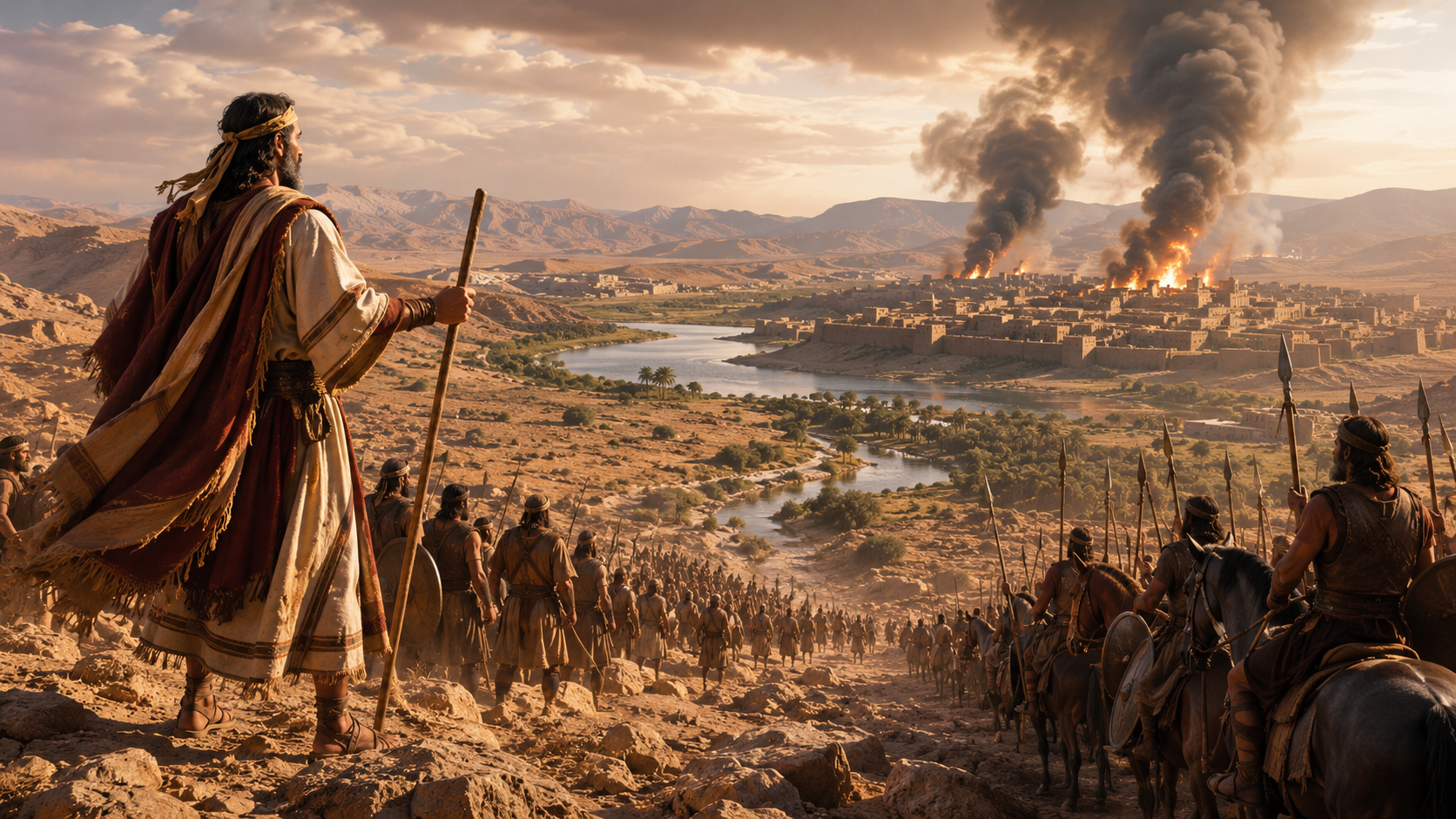
In context, we should remember that Abram and Lot just agreed to settle the differences between their families and go their separate ways. Lot was given first choice of land, and he chose the fertile plains of Jordan. Lot chose what seemed to be the best for a strong future. He left and set his tent toward Sodom (a people that were wicked and sinned exceedingly). Once Lot was gone, the Lord reminded Abram of His promise. He told Abram to look to the north, south, east, and west and know that God would give it all to him! Abram’s response was worship (13:18).
When Abram felt alone, God told him He was there. When Abram thought he had next to nothing, God promised him everything he needed. Before Abram had time to spiral into worry, anxiety, and fear over needed land resources, God reminded Abram of His promises! God met Abram in a vulnerable position and encouraged Abram’s spirit, affirmed His promises, and strengthened Abram’s resolve to follow Him. What kind of faith does Genesis 14-15 teach us we need?
There are 3 chairs we all come across in this life. The first chair is a battlefield chair. This is the chair that calls you to stand and fight for someone else. The second chair is a boardroom chair. This is where you are tempted to compromise for success or wealth. The third chair is a waiting room chair. This is where all you can do is wait and trust God to keep His promises. Sooner or later, every believer will sit in all three chairs. The question is not whether you will face those moments, but whether you will respond with faith in God! We need faith that rescues, refuses, and rest in God.
Faith That Rescues (Gen. 14:1-16)
There is no dogmatic declaration in scripture as to how much time has passed between end of the chapter and the beginning of chapter 14. However, there are a few clues:
Abram has built a substantial fighting force (Gen. 14:14).
The political situation had been developing for years (Gen. 14:4). By the time chapter 14 begins, the cities around the Dead Sea have been under foreign domination for twelve years.
Lot is well established in Sodom (Gen. 14:12). He is now living in Sodom and has accumulated a good deal of possessions.
Abram has established alliances with the local Amorite leaders (Mamre, Eshcol, and Aner; Gen. 14:13). Such relationships also suggests a reasonable amount of time has passed since the end of chapter 13.
Abram was 75 when he entered Canaan in Genesis 12:4 and he was 86 when Ishmael was born (Gen. 16:16). So, everything in that 11 year time span takes place in Genesis 13-15. For these reasons, it is most commonly believed that somewhere between 5 to 10 years has passed since Lot and Abram separated their families and chose different lands to settle.
A time of peace and assurance comes to an end in chapter 14. Lot, his family, and all of his possessions have been taken (Genesis 14:11-12). In the next verse (Genesis 14:13), Abram hears about his nephew’s troubles and gathers a small army of 318 men. Abram then pursues and defeats the enemy and brings back all the possessions and people to their homes in Sodom and Gomorrah.
If you saw a child wander into a busy street of traffic, you would not stand and debate in your mind what the safest way to help would be. Your feet would move before your mind finished the sentence!
That is what faith does. Faith acts when others are in need! Abram did not stop to consider the discord between their families some years earlier. Abram did not give pause to consider his own safety or needs. Abram hears of the happenings of war and captivity and gives chase! Genuine love will actively purse helping others rather than choosing to live comfortably.
Next month, we are organizing a food drive called “Love in Action.” This is a practical way to help others in the battle of financial hardship. Who needs you to step into their battle with prayer, encouragement, or practical help?
Faith That Refuses (Genesis 14:17-24)
After this war and rescue, Abram worships God with Melchizedek (Gen. 14:17-20)! Melchizedek is a king and a priest. He blesses Abram (14:19-20) and then Abram does a curious thing…Abram gives a tithe! A tithe is defined as giving a tenth of all income to the Lord.
My wife and I became grandparents last year. No one had to command us to buy clothes and toys. It became the natural response of love to want to provide good things. Love gladly gives. That is the response of Genesis 14.
Abram does not give his tithes because of a law. In fact, Abram’s tithe in Genesis 14:20 was about 400 years before the Mosaic law was established. Abram gives his tithes as a voluntary act of worship.
Abram’s tithe acknowledges that God gave him victory in war (14:20).
Abram’s tithe was given to the priest as an act of worship. It is an offering of thanksgiving.
The idea of giving a tenth of war spoils to a king was part of ancient Near East culture; however, Abram gives his tithe to the true God (not a pagan ruler or false god)!
Abram’s tithe declares that God was his greatest treasure! Immediately after giving this tithe, Abram refused great riches from the king of Sodom.
Faith values God’s blessing over the world’s rewards! Notice something. Immediately following victory, temptation steps forward. Great additional riches are offered to Abram, but he refuses the offer and even reveals his reasoning. Abram’s needs were already met! Abram did not want to take these great riches because he did not want anyone to think that his success came from anyone or anything other than God.
We are regularly tempted to compromise our integrity for money, for recognition, for comfort, or for influence. We are tempted to skip giving our tithes and offerings during the summer months for vacations, for travel, and for recreational choices. Afterall, the winter months are long and hard in central Wisconsin. Right? Did Abram struggle financially? He did not (Gen. 13:2), but I have never met a rich man who did not want to make more money! Abram refused an incredible financial opportunity for the sake of God’s glory. Is there something God wants you to refuse so He receives all the glory?
Faith That Rests (Genesis 15:1-21)
Abram is a man of great faith; however, he also struggles with fear from time to time. In Genesis 12:11-13, Abram was afraid the Egyptians would kill him to get Sarai for themselves. Genesis 15 begins with the phrase “After these things,” which points back to the events in chapter 14. Abram just finished a war with 4 powerful eastern kings. Will those kings come after him for revenge? Has he just made some very powerful enemies? Did he just do a foolish thing in refusing more wealth?
What is God’s solution to Abram’s fear? He reassures Abram with who He is (“I am your shield”) and what He will do (“your reward will be great”) in Genesis 15:1. Faith rests in God’s promises, works, and words!
In February 2023, after a massive heart attack, I was lying in the CCU. I had 3 IVs attached to my body. I was shocked twice while on the cath lab table, and I received two stents. The big shocker after all of that was that I could not move my left arm and leg. Doctor after doctor came into the room. I could not comprehend most of what they said because a different set of questions started flooding my head. Did I have a stroke too? Will I be able to walk again? Will we have to buy a different house (all our bedrooms and bathrooms were upstairs)? I just battled COVID for months on end, how am I going to managed church needs? Who is going to preach this Sunday?
The Divine solution to this human response is powerful! So, when those crazy questions start floating around in your mind during your battle ..and believe me they eventually will find their way in… where do you rest your faith?
What if I can’t pay medical bills or car repairs?
What if people believe the lies others say about me?
What if I can’t work in my more advanced years and only have limited retirement funds?
What if I lose my job?
What if I get the disease my parents or grandparents had?
What if influential people rise up against me?
Remind yourself of the person and work of God almighty! Rehearse who God is and what He has done, is doing, and will do. God is faithful and will not leave you or forsake you!
Abram chooses to believe God, and it is “counted for righteousness” (Gen. 15:6)! The word “counted” in Genesis 15:6 is an accounting term. It means to credit or to place in someone’s account. Righteousness was not something Abram earned. Righteousness was credited to his account. This is called “imputed righteousness.” Abram’s faith did not earn his salvation. Faith is the hand that receives God’s gift. Then God continues His pattern of confirming and affirming His promises with Abram!
We often will respond to Bible verses like these with, “I wish God would confirm and affirm His promises with me as well!” But He does! Think about it for a moment. You have more than Abram did:
You have the completed book of promises called the Bible.
You have the details of salvation revealed in scripture.
You have the modern day church.
You have the modern day church family gatherings every week.
You have Bible based preaching and teaching several times a week.
You have the calming affect of scripture on your heart and mind.
You have the guiding power of the Holy Spirit dwelling in you.